BJJ vs Taekwondo for Kids
One art kicks, the other grapples \u2014 both ask a lot of a child, in completely different ways. A fair comparison, from a school that teaches one of them and respects the other.
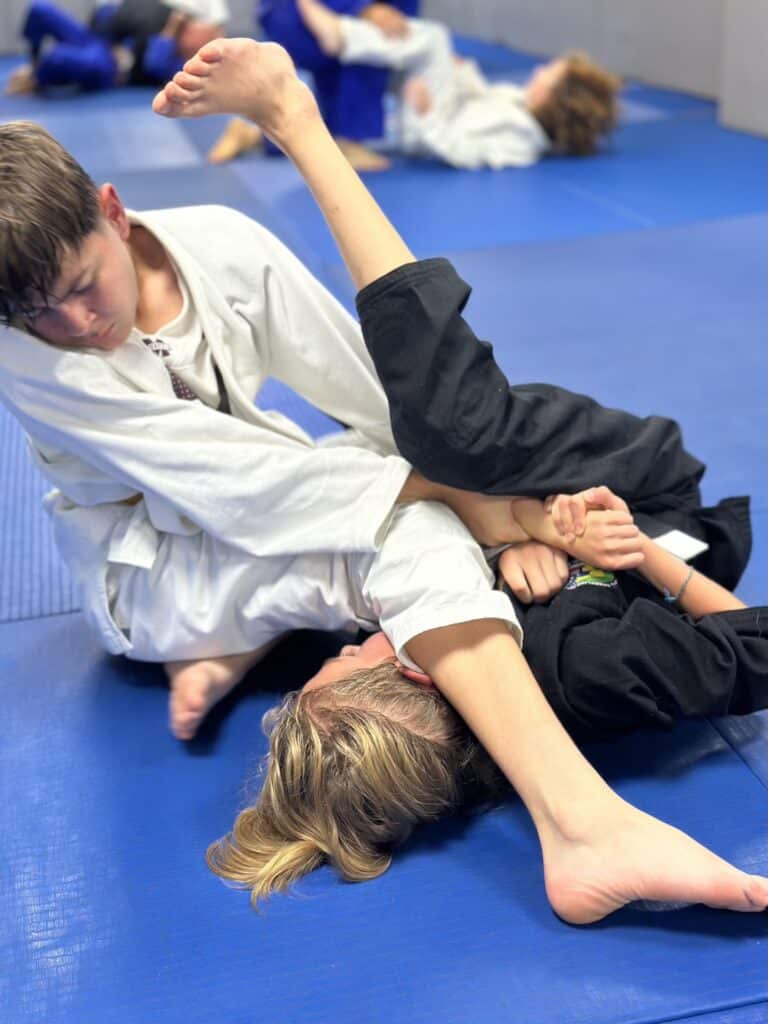
Put two eight-year-olds side by side. One is in the air, one leg extended in a clean, snapping kick aimed at a pad. The other is on the ground, using her legs like a fence to hold a partner off while she works out how to escape from underneath. Both are focused, both are sweating, and both will bow at the end of class. They are just learning very different arts. Taekwondo and Brazilian jiu-jitsu are the two names many parents here weigh first, so here is the honest comparison — bias declared: we teach jiu-jitsu, and taekwondo, taught well, is a fine art. The question is which one fits your child.
Two different answers to the same question
Parents usually arrive at both arts asking for the same things: confidence, discipline, fitness, and a child who can look after themselves. Taekwondo and BJJ answer that list from opposite directions. Taekwondo is a Korean striking art, famous above all for its kicks — high, fast, and athletic — supported by punches, blocks, set patterns of movement called forms, and sparring. Brazilian jiu-jitsu comes from the grappling side of the martial arts family: there is no striking at all. Children learn to fall safely, to hold and control a partner, to escape from underneath, and to solve a close-up physical problem using leverage instead of strength. One art works at arm's and leg's length. The other works in a clinch and on the mat. Almost every other difference flows from that one.
What a kids taekwondo class looks like
A taekwondo class is upright, orderly, and energetic. Children line up, bow, and warm up together, then drill techniques in lines or with a partner holding pads: front kicks, roundhouse kicks, side kicks, punches, and blocks, counted out loud. A good part of class goes to forms — choreographed sequences of strikes and blocks performed solo, which children memorize pattern by pattern as they advance through the belt ranks. Older and more advanced children spar under a points system, wearing protective gear, scoring with controlled kicks and punches. Many schools also practice board breaking for tests. The feel of the room is crisp and rhythmic: a child spends much of the hour on their own feet, at a distance, aiming at pads rather than wrestling a person. For a child who loves speed, jumping, and a technique they can see themselves land cleanly, it is easy to understand the appeal.
What a kids BJJ class looks like
A BJJ class is organized around a partner and the ground. After warm-up and movement, the coach demonstrates one technique in small steps — an escape from underneath, a sweep that reverses who is on top, a safe way to control a partner — and children drill it together, matched by age and size, before short, supervised live rounds, often starting from a set position. There are no forms to memorize and nothing is performed solo: nearly everything is practiced with another child, which means your child is reading a real person's movement and adjusting in real time. Matches are decided by positions earned and, for older children learning the art in full, by submissions — each of which stops instantly with the tap, the signal any child can use at any moment to end an exchange. We walk through the full arc in what actually happens in a kids BJJ class, minute by minute.
The differences that actually matter for a child
Strip away the uniforms and four practical differences remain. First, contact: taekwondo practice is mostly non-contact or light, controlled contact aimed at pads, targets, and — in geared sparring — scoring touches; BJJ is full, sustained contact, but with no strikes at all — holding, pressure, and escaping rather than hitting. Second, how a child succeeds: taekwondo rewards speed, flexibility, timing, and precision — a kick that lands exactly right. BJJ rewards patience and problem-solving — progress measured in inches, an escape earned a little at a time. Third, how progress is shown: taekwondo's belt tests lean on forms, technique demonstrations, and often board breaking, all of which a parent can watch and recognize; BJJ progress shows up inside live practice, which is subtler to see from the side of the mat. Fourth, the physical picture each art paints of a hard moment: taekwondo trains a child to keep distance and answer from range; BJJ trains what to do if a confrontation gets close or goes to the ground — how to protect yourself underneath someone bigger and get back to your feet. Neither art can honestly promise a child a particular outcome. Both build real skills; they are simply different shapes of skill.
Which fits your child?
After years of watching children meet martial arts for the first time, our honest guide is this. Lean toward taekwondo if your child loves big, fast movement — kicking, jumping, spinning — works happily on their own within a group, and lights up at clear solo goals like learning the next form or breaking a board at a test. Lean toward BJJ if your child is a solver: tactile, patient, happier wrestling and scrambling than performing a set pattern — or if the idea of strikes coming at them, even controlled ones in gear, would sour the whole thing before it starts. And if what you want most is the shared foundation — courtesy, routine, fitness, and respect for a coach and a room — either art delivers it, honestly taught. Let your child break the tie: watch one full class in each art before deciding. Our own kids jiu-jitsu program groups children by age — Little Grapplers (4–6) and kids (7–10), with teens in a group of their own — and if safety is your deciding question, we answer it directly in is BJJ safe for kids?
The fairest test is the same one we would suggest to a taekwondo parent: one real class, watched with your own eyes. At WDC BJJ the first class is free — a real group class with your child's own age group, no uniform, payment, or contract needed — and you watch from the side of the mat the entire time. Book a free class and see the grappling side up close. And if you visit a taekwondo school and your child cannot stop talking about the kicks on the drive home — follow that. The right art is the one they will still love a year from now.
Your first class is free.
A real group class with your own group. No experience needed, no payment, no contract for a trial — and enrollment includes a free uniform.
1. Send the free-trial request or call (202) 636-3453.
2. We confirm the right class for your age and schedule.
3. Arrive 15 minutes early in athletic clothes with water.
4. Train a real class — then decide with zero pressure.
BJJ or taekwondo, answered
Striking versus grappling. Taekwondo is a Korean striking art built around kicks — fast, high, and practiced at a distance — plus punches, set forms, and sparring scored by points. Brazilian jiu-jitsu has no striking at all: it is grappling, built around holding, escaping, controlling a partner on the ground, and, for older children, submissions that stop instantly with a tap. Both teach courtesy, discipline, and respect, and both group children by age. The training itself feels completely different.
Neither can honestly promise a child a particular outcome, and it is worth being wary of any school that does. The skills are simply different: taekwondo trains keeping distance, moving, and striking with the feet and hands; BJJ trains what to do at close range and on the ground — protecting yourself underneath someone bigger, escaping, and getting back to your feet. The more useful question is which art your child will stick with, because skills compound in the one a child actually keeps practicing.
Essentially, no — each art stays in its own lane. A kids BJJ class contains no punches or kicks at all; children learn takedowns at an age-appropriate level, positions, escapes, and control on the ground. A kids taekwondo class is built around striking technique, forms, and footwork, not ground grappling. That clear split is actually helpful: whichever class your child walks into, you know exactly what kind of contact to expect.
Both give an active child real work to do, in different ways. Taekwondo burns energy in bursts — kicking drills, footwork, and forms practiced in lines, largely on the child's own. BJJ burns it in sustained partner work: holding, escaping, and solving a physical problem against a partner of a similar age and size. Neither art can promise a particular change in a child. Watch how your child responds to each room — the one they ask to go back to is usually the honest answer.
No — we teach Brazilian jiu-jitsu, as part of GFTeam. We hold taekwondo in genuine respect: its kicking game is spectacular, its forms build precision and memory, and it is an Olympic sport with a clear competition path. If taekwondo is the better fit for your child, we will say so. If you want to see BJJ up close first, the first class is free, and parents watch from the side of the mat.