BJJ vs Judo for Kids
Two grappling arts from the same family tree — one built around the throw, the other around the ground. A fair comparison, from a school that teaches one of them and respects the other.
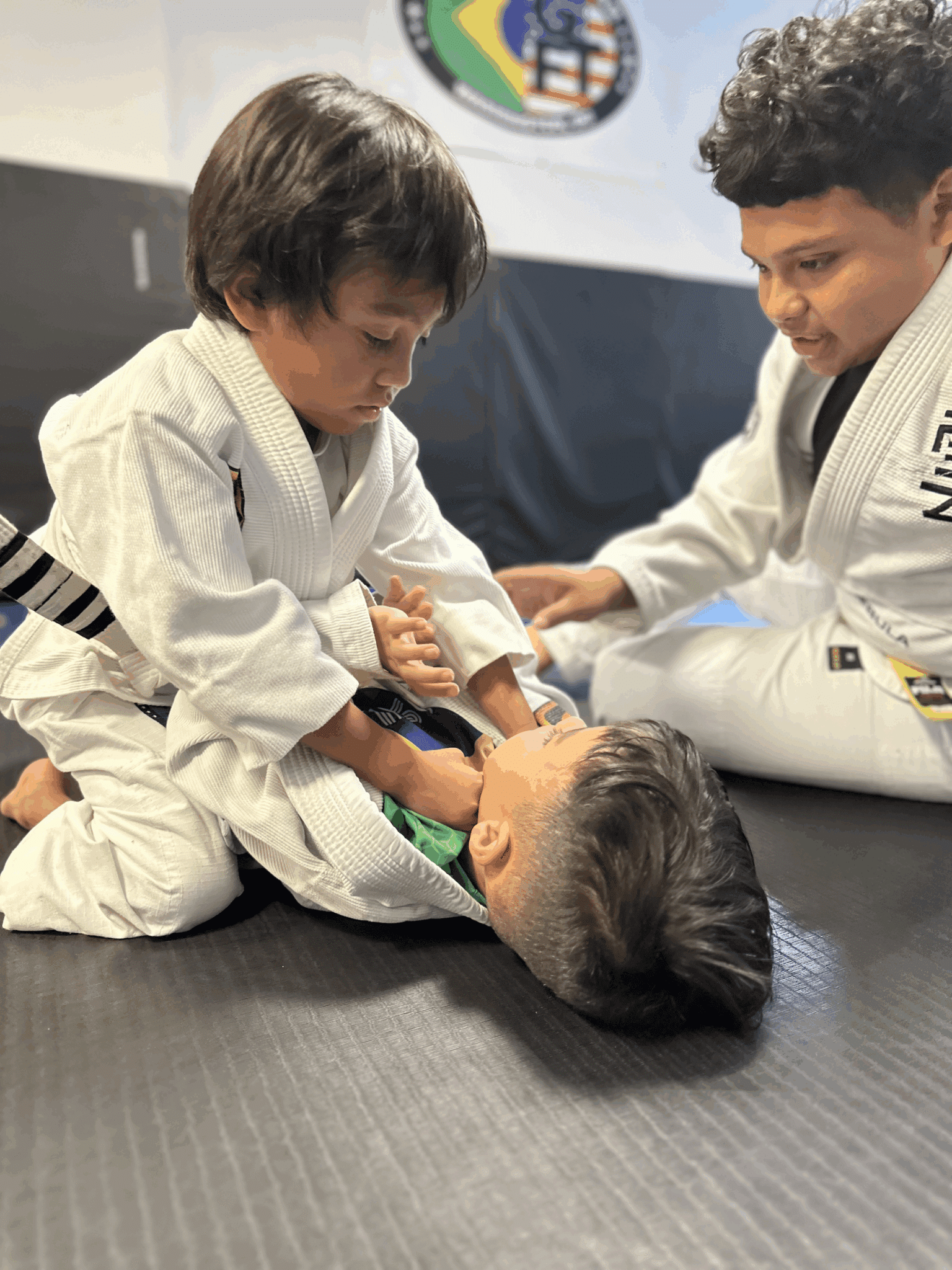
Here is a scene from every judo school in the world: a seven-year-old lands flat on her back on the mat — and pops up grinning, ready to be thrown again. Here is one from ours: a seven-year-old on his back, calmly using his legs like a fence to hold a bigger kid off, working on an escape the way you would work on a puzzle. Same gi, same family tree, two very different childhoods on the mat. If you are choosing between judo and Brazilian jiu-jitsu for your child, here is the honest comparison — written by a BJJ school, with the bias declared up front: we teach jiu-jitsu, and judo is excellent. The real question is not which art wins. It is which one fits your child.
Same roots, different center of gravity
Judo and BJJ are cousins. Judo was founded in Japan in 1882 by Jigoro Kano, who built it around throws that use balance, timing, and leverage rather than strength. Brazilian jiu-jitsu grew out of judo in the early 1900s — the lineage our own academy carries runs through Mitsuyo Maeda, a Kodokan judoka who brought the art to Brazil — and over the following century it shifted the emphasis from the throw to everything that happens after it: the groundwork. Neither art includes striking: no punches, no kicks. Both are practiced in a gi, both are built on respect and ritual, and both teach a child to fall without getting hurt. The difference is where each art keeps its heart. Judo starts standing and crowns the throw. BJJ starts wherever things land and crowns the ground.
What a kids judo class looks like
A judo class for children opens with movement and a great deal of falling. Ukemi — the art of landing safely — is judo's first skill and its most practiced one, and on its own it is worth a great deal to a child who climbs, runs, and occasionally comes off a bike. Then comes throwing practice: partners grip each other's gis, drill one throw step by step, and rehearse it onto thick crash mats before anyone throws at full commitment. Live practice starts standing, and in a match one clean throw onto the back can end everything at once — or a firm hold-down, pinned for a count of seconds. The feel of a judo class is explosive and upright: a child gets thrown many times in an hour and learns to treat the floor as a friend. If that picture makes your child light up, believe it. Judo's throwing game, taught well, is a beautiful thing.
What a kids BJJ class looks like
A BJJ class is organized around the ground. After warm-up and falling practice, the coach teaches one technique in small steps — an escape from underneath, a sweep that reverses top and bottom, a way to control a partner safely from the top — and children drill it with partners their own size before short, supervised live rounds, often starting from a set position on the ground. Where judo's decisive moment is the throw, BJJ's is the slow solve: How do I get out from under this? How do I use my legs as a frame and my hips as a lever? Matches are decided by positions earned and, for older children learning the art in full, by submissions — each of which stops instantly with the tap, the signal that ends everything the moment it is given. We walk through our class arc minute by minute in what actually happens in a kids BJJ class.
The differences that actually matter for a child
Strip away the history and four practical differences remain. First, where the action lives: judo is mostly standing, with short and decisive groundwork; BJJ is mostly groundwork, with brief standing starts. Second, how a child succeeds: the young judoka chases one big, clean moment, while the young jiu-jitsu player earns success inch by inch — different temperaments feel rewarded by different clocks. Third, the physical texture: judo asks a child to be thrown, a lot. The falling is taught meticulously and is designed to be the safest part of the art, but it is repeated impact onto mats. BJJ's load is spread differently — grappling contact, pressure, and problem-solving at close quarters, at a slower burn. Fourth, the picture each art paints of a hard moment: judo trains the fall, the throw, and the pin; BJJ trains what to do if a confrontation ends up on the ground — how to protect yourself underneath someone bigger and get back to your feet. Neither art can honestly promise a child a particular outcome. Both build real skills; they are simply different shapes of skill.
Which fits your child?
After years of watching children meet grappling for the first time, our honest guide is this. Lean toward judo if your child loves big movement — running, jumping, throwing, being thrown — and lights up at clear, decisive moments: one beautiful throw, and it is done. Lean toward BJJ if your child is a solver: patient, tactile, happier wrestling on the floor than flying through the air — or if being thrown twenty times in an hour would sour the whole thing before it has a chance to start. And if what you want most is the shared foundation — safe falling, balance, fitness, respect, and calm under pressure — either art delivers it, honestly taught. Let your child break the tie: watch one full class in each art before deciding. A six-year-old's grin in the car afterward is better data than any comparison, ours included. Our own kids jiu-jitsu program groups children by age — Little Grapplers (4–6) and kids (7–10), with teens in a group of their own.
The fairest test is the same one we would suggest to a judo parent: one real class, watched with your own eyes. At WDC BJJ the first class is free — a real group class with your child's own age group, no uniform, payment, or contract needed — and you watch from the side of the mat the entire time. Book a free class and see the ground game up close. And if you visit a judo school and your child cannot stop talking about the throws on the drive home — follow that. The right art is the one they will still love a year from now.
Your first class is free.
A real group class with your own group. No experience needed, no payment, no contract for a trial — and enrollment includes a free uniform.
1. Send the free-trial request or call (202) 636-3453.
2. We confirm the right class for your age and schedule.
3. Arrive 15 minutes early in athletic clothes with water.
4. Train a real class — then decide with zero pressure.
BJJ or judo, answered
Emphasis. Judo starts standing and is built around throws and pins — one clean throw onto the back can end a match. Brazilian jiu-jitsu is built around groundwork: positions, escapes, control, and, for older children, submissions that stop instantly with a tap. Both are grappling arts with no striking, both are practiced in a gi, and both teach children to fall safely.
Neither can honestly promise a child a particular outcome, and it is worth being wary of any school that does. What each art trains is different: judo trains falling safely, throwing, and pinning; BJJ trains protecting yourself on the ground, escaping from underneath, and getting back to your feet. The more useful question is which art your child will stick with — skills compound in the one a child actually keeps practicing.
Yes, but fewer of them, and they are not the center of the art. BJJ classes include takedowns and standing starts at an age-appropriate level, and children practice falling safely. Judo teaches throwing in far greater depth — it is the heart of judo. In BJJ, most of a child's training time goes to what happens on the ground once the throw is over.
Yes. The two arts share roots, a gi, and a movement vocabulary, so skills transfer in both directions: grips, balance, falling, and comfort with close contact all carry over. Many students switch or cross-train as their interests change. Starting in one does not lock a child out of the other.
No — we teach Brazilian jiu-jitsu, as part of GFTeam. We hold judo in genuine respect: its throwing game is excellent, and its falling practice is the finest in the martial arts. If judo is the better fit for your child, we will say so. If you want to see BJJ up close first, the first class is free, and parents watch from the side of the mat.