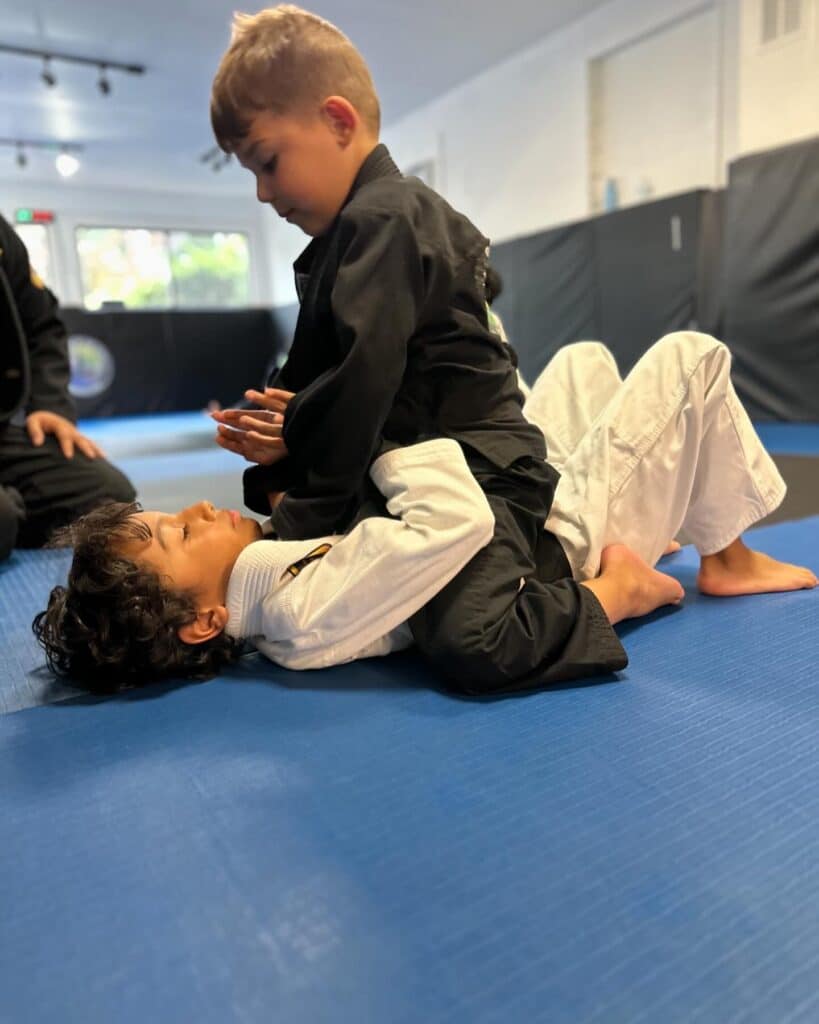
Martial Arts for Kids in Montgomery County: A Parent's Guide to Choosing
Karate, taekwondo, judo, wrestling, or jiu-jitsu? An honest, even-handed guide from a Takoma Park academy — written to help you choose well, wherever you enroll.
If you are comparing martial arts for your child in Montgomery County — Takoma Park, Silver Spring, Bethesda, Rockville, or anywhere nearby — you will meet the same five arts again and again: karate, taekwondo, judo, wrestling, and Brazilian jiu-jitsu. All five are real martial arts with real benefits. They differ in what children actually do in class, and that difference — not the logo on the door — is what should drive your choice. We teach Brazilian jiu-jitsu, and only jiu-jitsu. We wrote this guide to be useful even if you never visit us: what each art is, what a typical class looks like, and the questions worth asking any school, including ours.
The distinction that explains almost everything: striking vs. grappling
Karate and taekwondo are striking arts: children learn to punch, kick, and block, and to manage distance from a partner. Judo, wrestling, and Brazilian jiu-jitsu are grappling arts: children learn to clinch, throw or take a partner down, control them on the ground, and escape. Neither family is "better." Striking arts build coordination, timing, and confidence at range. Grappling arts build close-range control and are practiced against fully resisting partners from early on, which is why grappling classes tend to look like joyful, structured roughhousing — and why many parents of kids who get grabbed, pushed, or held at school gravitate toward them. Hold this one distinction in mind and everything below falls into place.
How to use this guide
Read the five cards below for the plain facts on each art. Then use the questions at the end on every school you visit — a trial class tells you more than any website, this one included.
What each one actually teaches
Karate
A typical class: Warm-ups, basic strikes and blocks, kata (choreographed forms practiced solo), pad work, and — for older or advancing kids — controlled sparring in protective gear.
Self-defense approach: Keep distance, block, and strike back.
Competition path: Local and national tournaments in kata and point sparring; a deep traditional circuit.
Gear: A karate gi and belt; pads and gloves as they advance.
Typical starting ages: 4–6.
Taekwondo
A typical class: Dynamic warm-ups, kicking drills on pads and targets, poomsae (forms), board breaking on occasion, and Olympic-style sparring for advancing students.
Self-defense approach: Distance and powerful kicks; hands play a smaller role.
Competition path: A full Olympic sport in sparring, with poomsae competition at every level.
Gear: A dobok (uniform) and belt; sparring armor, helmet, and pads as they advance.
Typical starting ages: 4–6.
Judo
A typical class: Falling practice (ukemi) first, then partner throws, hold-downs (pins), and supervised randori — live practice rounds.
Self-defense approach: Off-balance and throw someone who grabs you, then control them on the ground.
Competition path: An Olympic sport with a clear junior pipeline, from local events to national teams.
Gear: A heavy, reinforced judogi and belt — the toughest uniform of the five, built to be grabbed.
Typical starting ages: 5–6; some clubs take 4-year-olds.
Wrestling
A typical class: Intense warm-ups and conditioning, takedown and escape drills, and live practice with partners matched by size.
Self-defense approach: Stay on your feet, take the other person down, control them or get away. No submissions and no striking.
Competition path: The scholastic ladder — youth leagues, middle- and high-school teams (folkstyle), then freestyle and Greco-Roman, and college wrestling.
Gear: Practice gear or a singlet, wrestling shoes, and headgear for competition.
Typical starting ages: 5–6 in youth clubs; school teams start later.
Brazilian Jiu-Jitsu
A typical class: Warm-ups and movement drills, a technique taught step by step, partner drilling, and — every class — live rounds at an intensity coaches scale to the child.
Self-defense approach: Close the distance, take things to the ground where size matters less, then control, escape, or — for older kids, carefully supervised — apply a submission.
Competition path: A large kids' circuit (IBJJF, AJP, NAGA and others) with divisions by age, weight, and belt.
Gear: A gi and belt; a rash guard and shorts on no-gi days.
Typical starting ages: 4–5. Our Little Grapplers start at 4.
Questions to ask any school before you enroll
1. Who actually teaches the kids' classes? Ask about the experience of the person who will be on the mat with your child — not just the academy's owner.
2. Can we watch a full class first? Good schools say yes without hesitation.
3. How are partners matched? By size, age, and experience — and ask how smaller or shyer kids are protected while they learn.
4. What does the trial look like? You want a real class with the real group, not a private sales appointment.
5. How do promotions work? On a test day, on the coach's judgment, or both? How often, and what do they recognize besides technique?
6. What gear does my child need on day one — and what gets added later? A straight answer here prevents surprises everywhere else.
7. How big are the kids' classes, and how many coaches are on the mat?
8. What happens if my child wants to stop? A fair question at any school, and the answer tells you how the school treats families.
A good school answers every one of these happily. If a school pressures you to decide on the spot, that is also an answer.
Where we fit — honestly
We are a Brazilian jiu-jitsu academy in Takoma Park, family-owned, teaching kids ages 4–12 and teens a few minutes from Silver Spring and the DC line. If this guide points your family toward karate or judo instead, it has done its job — the right art is the one your child will still love in six months. If you want to see grappling up close, start with our deeper karate vs. jiu-jitsu comparison, look at the kids program and Little Grapplers (ages 4–6), or simply come watch a class: the first class is free, and you can book it online.
Your first class is free.
No experience needed, and no contracts or long-term commitment — just come train. Enrollment includes a free uniform for kids, youth, and adults.
1. Send the free-trial request or call us.
2. We confirm the right class for your age and schedule.
3. Arrive 15 minutes early in athletic clothes.
4. Train in a real group class — then decide with zero pressure.