BJJ vs Karate for Kids: An Honest Comparison
Both teach real discipline. They teach very different skills — here is the fair breakdown parents actually need before choosing.
It is one of the first decisions a parent makes, and it usually comes down to two names: karate or jiu-jitsu. Both are real martial arts with long histories, real discipline, and good schools in our area. They are not interchangeable, though. They teach the body to solve different problems — and for most families, once the difference is clear, the choice gets easier. Here is the honest comparison we would want if we were choosing for our own kids.
The one-sentence difference
Karate is a striking art: punches, kicks, blocks, and set forms (kata), practiced mostly at arm's and leg's length from a partner. Brazilian jiu-jitsu is a grappling art: closing the distance, taking a partner to the ground, and controlling them there with leverage, pins, and — for older students — submissions. A karate kid learns to hit a target and not get hit. A jiu-jitsu kid learns to hold, escape, and control without hitting anyone at all. Everything else in this comparison flows from that one difference.
What a karate class teaches
A good karate school gives a child strong habits: standing at attention, bowing in, learning forms with precision, and building coordination and flexibility through kicks and strikes. The structure is clear and predictable, the belt ladder is visible, and many children — especially ones who love routine and solo mastery — thrive in it. Karate also teaches distance: how to stay out of reach and make space. None of that is small. If your child lights up watching a crisp kata, that interest matters more than any comparison chart.
What a jiu-jitsu class teaches
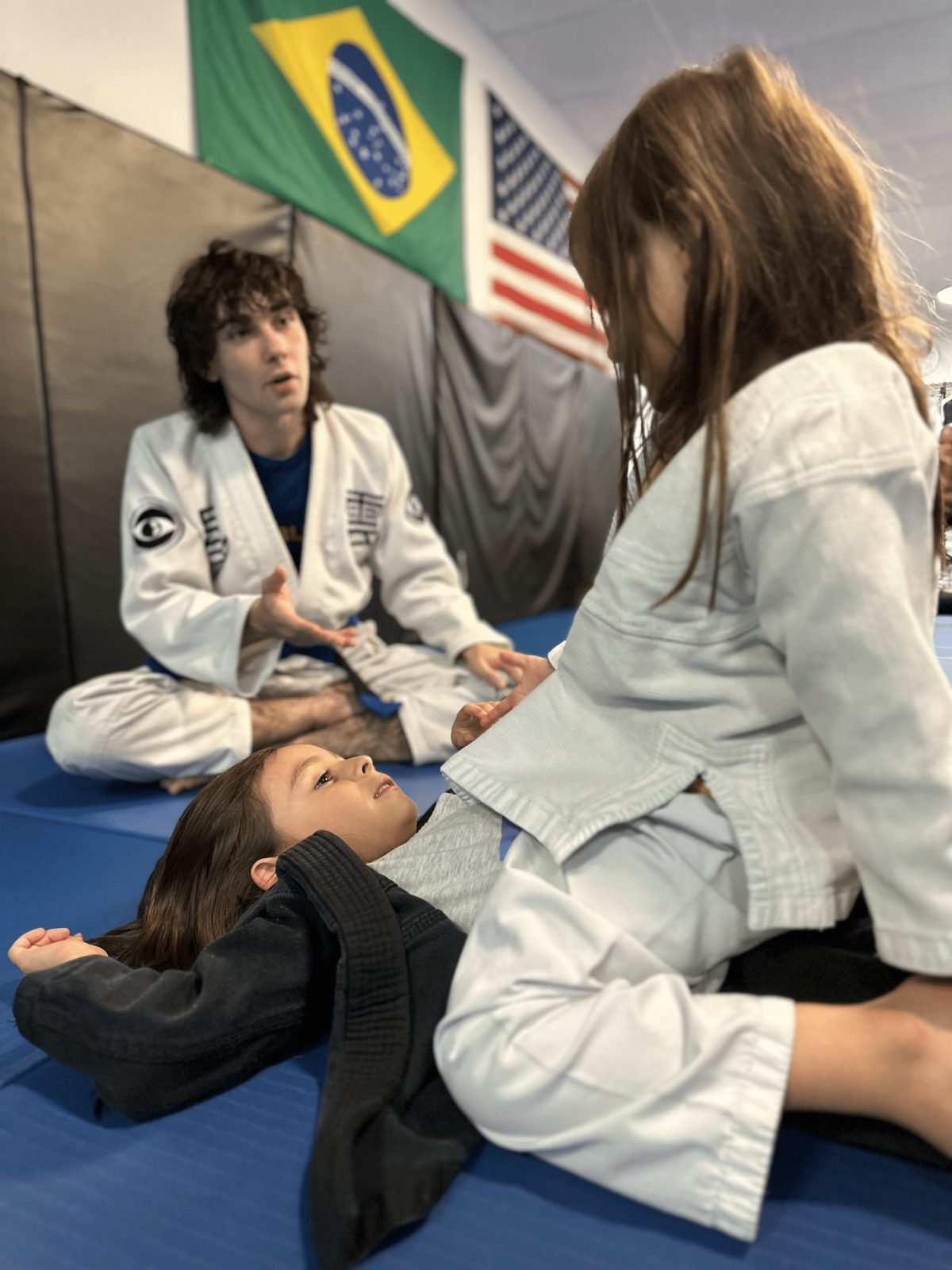
In our kids' program at WDC BJJ in Takoma Park, children ages 4–12 learn how to fall safely, how to get up when someone is holding them down, how to escape the common grabs and pins of the playground, and how to control a partner using position and leverage instead of strength. Classes are partner work from the first week: kids drill a technique together, then practice it against gentle, supervised resistance. Because the art was built so a smaller person can handle a bigger one, size matters far less than in most sports — which is part of why so many parents of smaller kids end up here. Our martial arts for kids guide walks through how the age groups work.
The self-defense question, honestly
Parents rarely say it out loud, but the real question is usually bullying. Here is the honest version. Most physical conflicts between children do not look like a boxing match — they look like grabbing, pushing, being held down, a headlock in a hallway. That is grappling territory, and it is exactly what jiu-jitsu trains every class. Jiu-jitsu also gives a child an option striking arts cannot: control without hitting back. A child who can take a bully down, hold them safely, and wait for an adult has solved the problem without throwing a punch — something schools, with their zero-tolerance policies, tend to view very differently. Karate's honest strength is the opposite end of the fight: keeping distance and escaping before anything starts, which is genuinely valuable too. What neither art honestly promises is that a child becomes untouchable. Any school that guarantees that is selling, not teaching.
Safety inside the training itself
In kids' jiu-jitsu, techniques are practiced at controlled speed with a partner who is cooperating, and the tap — a simple signal that stops everything instantly — is taught on day one and respected absolutely. There is no striking, so there are no blows to the head. In karate, most kids' classes use light or no-contact sparring, though the level of contact varies more from school to school, so it is worth asking directly. At either kind of school, the questions that matter are the same: How big are the classes? Who supervises partner work? What happens when a child says stop? A good school answers all three without blinking.
Which fits your child?
Some honest generalizations from years of watching both: children who are shy or anxious often settle faster in jiu-jitsu, because success is built from small, physical wins — escaping a pin feels like proof, not performance. High-energy kids do well in both, but jiu-jitsu's constant partner work burns energy in a way solo forms sometimes do not. Children who love precision, choreography, and performing a form exactly right often love karate. And plenty of kids would be happy in either — in which case the deciding factors are the school, the coaches, and the feel of the room, not the art.
What trying it looks like
At WDC BJJ, a trial is not a sales appointment — it is a real class. Your child joins a group class for their age group, in athletic clothes, with a water bottle, while you watch from the side. No uniform is needed for a trial, no payment, no contract. Arrive about fifteen minutes early and let them feel the room. If your child is also curious about karate, visit a karate school the same week and compare honestly — then watch which class they talk about at dinner. That is usually your answer. Book a free class and let them test it themselves.
Your first class is free.
A real group class with your own group. No experience needed, no payment, no contract for a trial — and enrollment includes a free uniform.
1. Send the free-trial request or call (202) 636-3453.
2. We confirm the right class for your age and schedule.
3. Arrive 15 minutes early in athletic clothes with water.
4. Train a real class — then decide with zero pressure.
Comparing the two, answered
They solve different problems. Karate teaches distance, striking, and escaping before contact. Jiu-jitsu teaches what to do once contact happens — the grabs, holds, and pins most childhood conflicts actually involve — and lets a child control a situation without striking anyone. For bullying specifically, many parents choose the control-without-hitting option.
Kids' classes are built around control: techniques are drilled at a cooperative pace, partner work is supervised, there is no striking, and the tap — a signal that stops everything immediately — is taught on the first day. Children train in age groups (our youngest group is ages 4–6) so partners are matched by size and maturity.
Many shy kids settle well in jiu-jitsu because progress is private and physical — you escape a pin or you don't — rather than performed in front of the room. That said, a predictable, routine-driven karate class suits some quiet children better. The free trial exists precisely so you can watch your own child instead of guessing.
Our kids' program starts at age 4 and runs to age 12, with teens (13–17) training in their own group. Children start karate at similar ages. Readiness matters more than birthdays: listening for a short class, taking turns, and being willing to try.
Yes. The first class is free at WDC BJJ — a real group class for your child's age group, with no uniform, payment, or contract needed. Book a class, come watch from the side, and compare it with any other school you are considering.