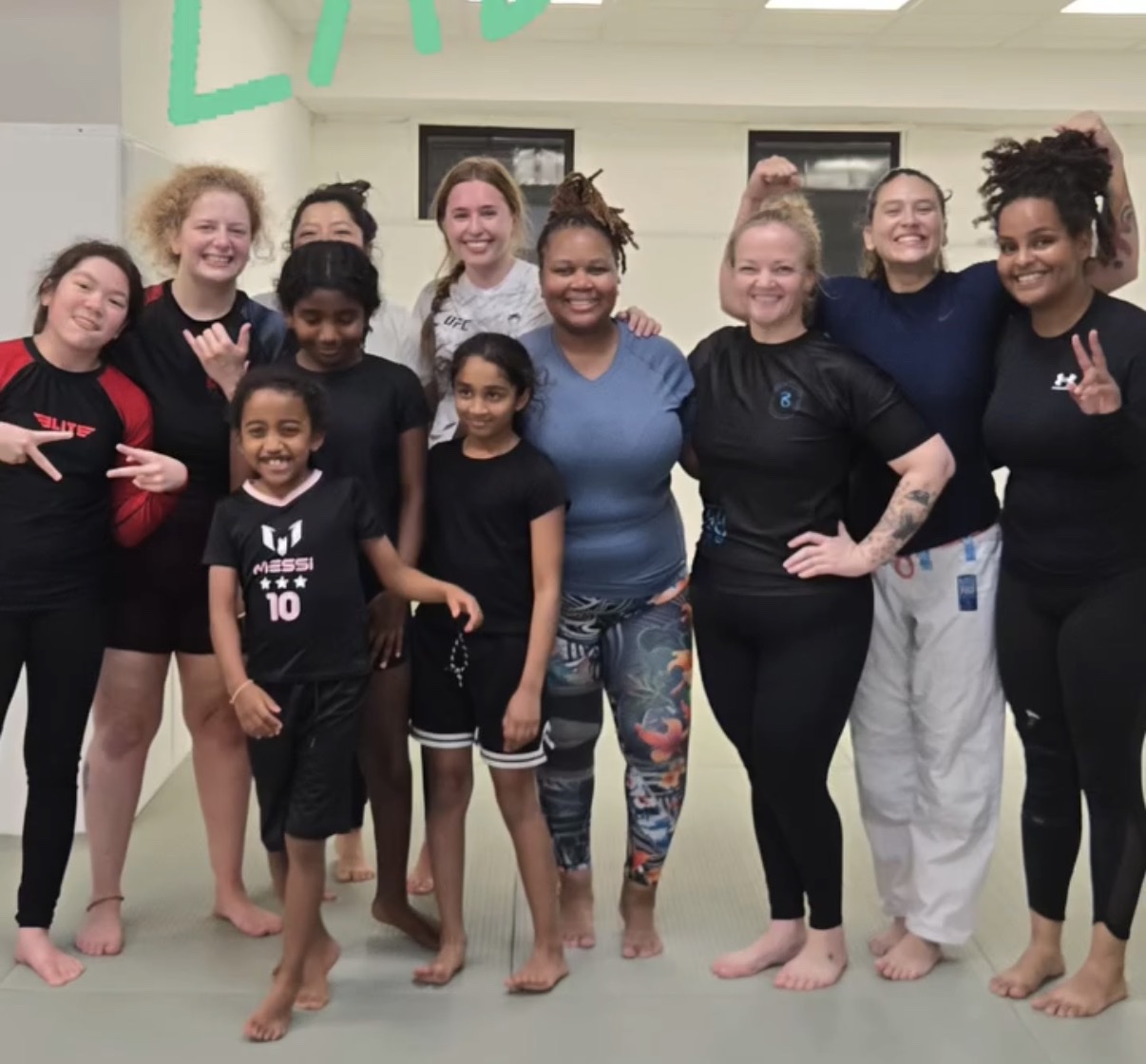
Women's Self-Defense Classes in Takoma Park: What BJJ Actually Teaches You
Escapes, leverage, and composure — what jiu-jitsu self-defense really is, what a women's-only class looks like, and how to try one free.
If you have searched for self-defense classes in Takoma Park, Silver Spring, or Northeast DC, you already know the question underneath the search: if someone grabbed me — by the wrist, by the arm, from behind — would I know what to do? That is exactly the question Brazilian jiu-jitsu was built to answer, and it is why our women's program at WDC BJJ teaches self-defense through jiu-jitsu. This guide explains what that training actually involves, what a women's-only class looks like from the inside, and how to try one.
WDC BJJ is a family-owned Brazilian jiu-jitsu academy at 720 Erie Ave, Takoma Park, MD 20912, part of this neighborhood since 2015 and part of GFTeam, one of the most respected jiu-jitsu teams in the world. Our women's program is led by Professor Charlene Dixon, a GFTeam black belt who heads women's training at the academy — so from your first class on, you are learning from a woman who has spent years on these mats.
What self-defense actually means in jiu-jitsu
Jiu-jitsu self-defense starts from the situations women actually describe worrying about — not choreographed attacks, but grabs and holds: a wrist seized and pulled, an arm grabbed, being grabbed from behind, being pushed against something, being held down. Those are close-range, physical problems, and they are the problems this art trains every single class.
The core skills are escapes and control. You learn how to break grips and free a grabbed wrist or arm. You learn how to use leverage, angles, and your whole body — hips, legs, frames — instead of arm strength, so technique does the work that size does not have to. You learn how to protect yourself on the ground, how to escape from underneath a heavier person, how to get back to your feet safely, and how to control distance once you are standing. The goal in a real situation is never to "win a fight." It is to get free, get up, and get away — and that is the sequence jiu-jitsu rehearses, with real resistance, week after week.
Just as important is composure. In training you practice staying calm while someone bigger applies pressure, thinking through a problem instead of panicking. That habit — breathe, frame, escape — is a skill like any other, and it only comes from live practice, which is why our students drill and roll with partners rather than only rehearsing movements in the air.
Why grappling fits a smaller person
Every serious martial art trains something real, and striking arts build genuine skill, timing, and toughness. But striking asks you to trade power at arm's length, and power scales with size, reach, and strength — a trade that usually favors the bigger person. Jiu-jitsu was developed around the opposite idea: that a smaller, weaker person can defend herself against a larger attacker using leverage and technique instead of force.
There is a second, practical reason. Confrontations that turn physical rarely stay at arm's length. They clinch, they grab, they stumble and fall — they end up exactly where jiu-jitsu lives: close, tangled, and often on the ground. Training the range where incidents actually happen, against partners who are genuinely trying to hold you, is what turns a technique from something you have seen into something your body does under stress.
The women's-only classes at WDC BJJ
Our women's-only classes meet three times a week: Monday at 6:00 PM (No Gi), Wednesday at 6:00 PM (Gi), and Saturday at 11:00 AM (Gi). No-gi training is done in athletic clothing; gi training uses the traditional uniform. Many students attend a mix of both, because the same escape can look slightly different with and without the uniform to grip.
Training in both formats matters for self-defense. The gi gives a partner clothing to grip — collars, sleeves, jackets — which is realistic practice for grabs involving everyday clothes, while no-gi training teaches the same escapes when there is nothing to hold onto but wrists, arms, and body position. An escape that works in both is an escape you can trust, and alternating between the two across the week is how most of our students build that reliability.
A typical class follows a steady rhythm: a warm-up built around jiu-jitsu movements, one technique taught step by step by Professor Charlene, partner drilling at a controlled pace, and then supervised practice rounds for those who want them. Partners are matched thoughtfully by size and experience, and one rule governs the whole room: tapping out stops everything, instantly, every time — the moment anyone taps or says stop, the technique ends and both partners reset. You can also sit out any drill, any round, any day, no questions asked. The room's culture is deliberate: supportive, focused, and free of the ego you might picture from a fight gym. You can read more about how self-defense runs through everything we teach on our Self-Defense Through BJJ page.
Your first class, as a complete beginner
Most women in our program started with no martial arts experience at all, so the beginner path is the normal path. Your first class is a free trial — a real class with our regular students, not a sales session. Arrive about 15 minutes early, wear comfortable athletic clothes, and bring a water bottle; you do not need a uniform to try a class. Check in at the door, meet Professor Charlene, and you will be paired with a partner who knows it is your first day.
Expect to move, to learn one or two concrete escapes, and to leave a little tired and a lot clearer about what this training is. After the trial, most students settle into two classes a week — enough repetition for the escapes to become reflexes rather than memories, and a pace that fits around work, school runs, and everything else. Each week builds on the last: the same core positions return in new combinations, so progress shows up as calmer reactions and cleaner escapes long before it shows up as a new belt.
If you decide to enroll, enrollment includes a free uniform, so there is no separate gear purchase to get started. And if you want a fuller picture of the weekly schedule before you book, our class schedule page lists every program we run.The honest limits
Here is the part every self-defense school should say plainly: no class — ours or anyone else's — can guarantee your safety, and any program that promises that is selling you something false. Real-world situations are unpredictable, and awareness, judgment, and avoidance will always be the first layer of self-defense. Training supports those layers: people who train tend to notice more, carry themselves with more composure, and react instead of freezing when something feels wrong. But the techniques themselves are skills, and skills are built over months of consistent practice — not in a single seminar, and not by watching videos. What we can promise is honest coaching, real technique practiced live, and a room full of women working on the same skills beside you.
How to start
Starting is simple. Book a free trial class and tell us you would like a women's class, or call us at (202) 636-3453. Pick the session that fits your week — Monday 6:00 PM no-gi, Wednesday 6:00 PM gi, or Saturday 11:00 AM gi — arrive 15 minutes early in athletic clothes with water, and train. After class we will answer your questions and, only if you want, walk you through how enrollment works. No payment and no contract are involved in a trial — just one real class, and then your decision.
Your first women's class is free.
A real women's-only class with Professor Charlene and our regular students. No experience needed, no payment, no contract for a trial — and enrollment includes a free uniform.
1. Send the free-trial request or call (202) 636-3453.
2. Pick a women's class: Mon 6 PM, Wed 6 PM, or Sat 11 AM.
3. Arrive 15 minutes early in athletic clothes with water.
4. Train a real class — then decide with zero pressure.