The Belt Journey
What each belt means, how kids earn stripes, and how promotions are decided at WDC BJJ — a map of the road, with no timelines promised and no shortcuts sold.
Belts are earned — and here is exactly how
Every promotion at WDC BJJ — every stripe, every belt, for kids and adults alike — is the coach’s decision, based on three things: attendance, attitude, and skill. Show up consistently. Train with respect for your partners and the room. Build real technique that works under pressure. When a student is genuinely ready, the coach promotes them — in class, in front of the teammates who helped them get there.
There is no fixed timeline, no belt is ever guaranteed, and no one buys a promotion. That is not a loophole — it is the reason a belt from a serious academy means something everywhere in the jiu-jitsu world. The ranges below are typical across the sport, shared so families can picture the road honestly. Your road will be your own.
The adult path: white to black
The beginning
Survival first: how to fall safely, tap, escape bad positions, and move on the ground. Most adults spend one to two years here — the widest, steepest learning curve in the sport, and the most fun per class.
A working game
You can defend yourself against an untrained person and a newer student: real escapes, guard play, and your first submissions chained together. Typically earned after a few years of regular training.
Your own game
Technique becomes personal — you build a style around your body and your strengths, and you start helping newer students find theirs. Commonly a multi-year belt.
Details & pressure
The game sharpens: timing, pressure, and the small details that separate good from excellent. Brown belts often coach, corner teammates, and refine everything for the final step.
The long road, earned
Across the sport, black belt is commonly a decade-plus journey of consistent training. It marks mastery of the fundamentals and the start of a different kind of learning — our head coach, Professor Deivid Dias, holds his black belt in the Fadda lineage of GFTeam.
Progress, marked
Between belts, students earn up to four stripes — small milestones the coach awards as attendance, attitude, and skill add up. A stripe is the coach saying: you are closer than you were, keep going.
The kids belt & stripe system
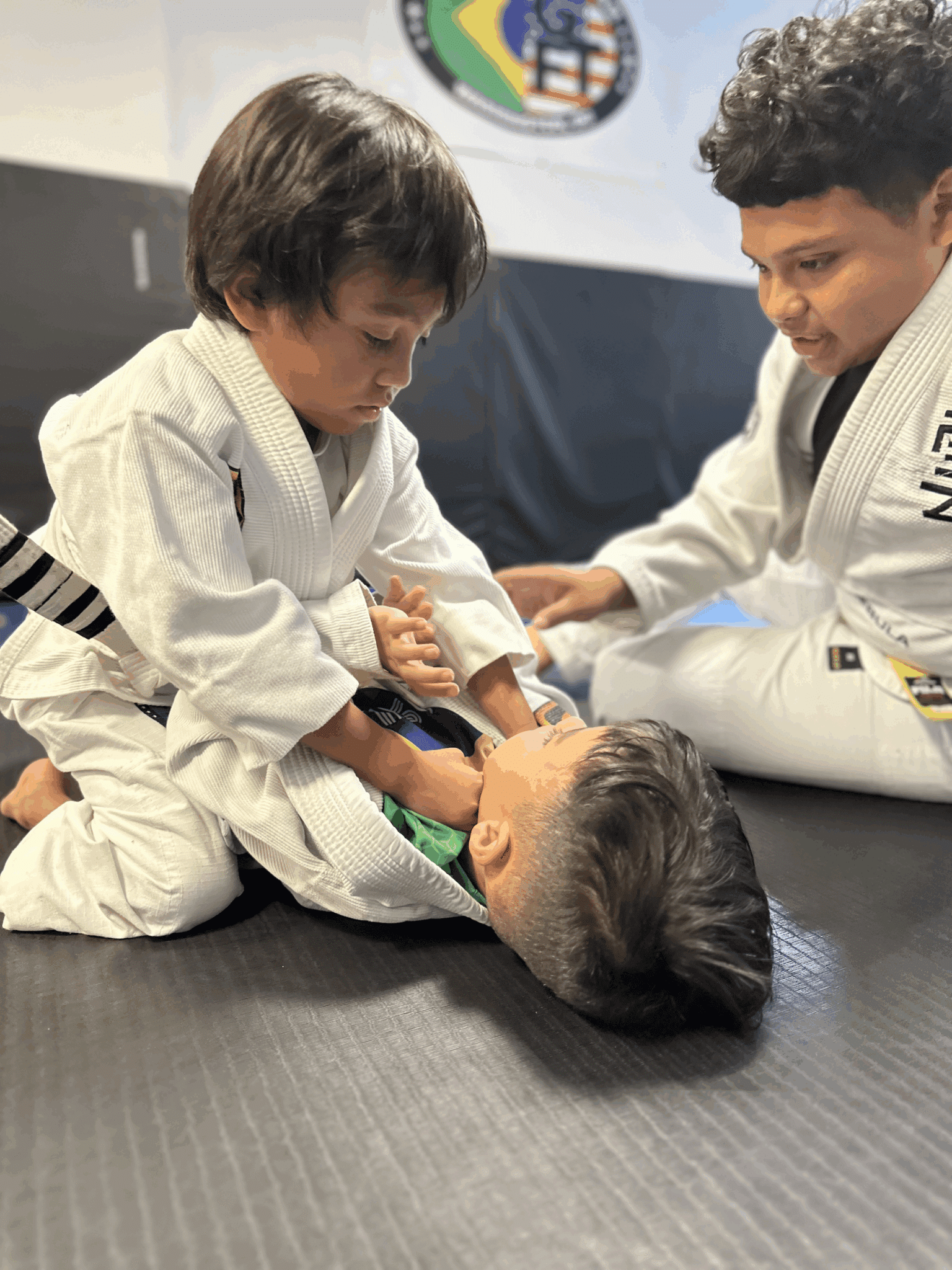
Kids follow the youth belt path used across Brazilian jiu-jitsu: white → gray → yellow → orange → green, with white- and black-striped versions between each color (gray-white, gray-black, and so on). Within every belt, kids earn up to four stripes for attendance, attitude, and skill — so a child is never more than one good stretch of training away from their next visible win.
That rhythm matters. A stripe tells a seven-year-old, in a language they understand, that showing up and trying hard is noticed and named. Parents are always part of the moment — promotions happen in class, with the whole room applauding.
Around age 16, teens transition toward the adult belt ranks (blue and beyond), with placement decided by their coach based on their actual training — nobody restarts from zero, and nobody skips the standard either.
Belt journey FAQ
Across the sport, a decade or more of consistent training is typical — and it varies enormously by how often a person trains. Anyone who quotes you an exact number is selling something. What we can promise is the standard: every promotion here is earned on attendance, attitude, and skill.
Promotions are the coach’s decision, not a test you schedule or a rank you can skip. When the coach sees a student is ready — in regular classes, over time — the promotion happens.
Kids use the youth belt system (gray, yellow, orange, and green families) because children earn rank from age four. Adults wear white, blue, purple, brown, and black. Teens transition to the adult ranks around age 16, placed by their coach.
Life happens — especially with kids. Students keep the stripes and belts they’ve earned; the coach simply picks the journey back up from where the student actually is when they return.